
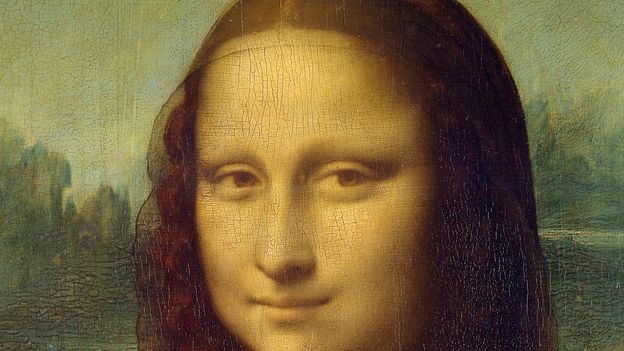
I read something pretty interesting recently, a throwaway comment about the most famous painting by the most famous painter not being anyone’s favourite piece of art. In current social contexts, no-one seems to have a personal connection with the Mona Lisa. At first I didn’t pay it much attention, but then I thought about it. No-one has the Mona Lisa in print at home, or has her as a fridge magnet or screensaver. No-one in social conversation says how they like it or find it interesting. Yet it is the most famous painting with huge queues at the Louvre to get a photo of it. Everyone knows the Mona Lisa and knows it’s famous, but why?
To preface this, I am far from knowledgeable about art. However, I am a (novice) art enjoyer. I realised that my favourite pieces of art – Drowning Girl by Roy Lichtenstein, The Great Wave off Kanagawa by Hokusai and all of Keith Haring’s work – had a kind of poignant relevance and a story behind them. Upon further reflection of these, I realised they each held a personal significance and meaning to me.
Drowning Girl
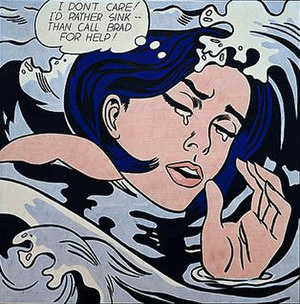
It’s not an exaggeration when I say this piece of art changed my life. Drowning Girl was the first piece of art that spoke to me; as a feminist from a young age, seeing that a woman would rather drown and die than see a man who had most likely wronged her come to her rescue (or even know she was vulnerable) was pretty inspiring. I remember thinking to myself: hell yeah, why should she need a man’s help, and when have they ever helped before? It seemed confident and independent, as well as arrogant and ironic, and despite likely not being intended to be so deep (as perhaps much art is) I took great joy and meaning from it. Everyday I try and emulate this unnamed hero, reveling in the melodrama and vehemently refusing to return to a presumably toxic man who hadn’t treated her right. I genuinely carry this with me all the time, throughout all my romantic encounters; I don’t care, I would literally rather sink than call a toxic man for help!
The Great Wave off Kanagawa

The Great Wave (which funnily enough is said to have inspired Lichtenstein’s work) I found beautiful and imposing. There’s a sense of juxtaposed serenity and doom which is hard to explain or replicate. The Great Wave is Hokusai’s most famous piece and is originally a woodblock print, created in the early 1800s. It is said to have inspired several Western musicians and artists, including Debussy and Monet. I remember reading once in a museum that this was possibly intended to be viewed right to left, rather than (typically Western) left to right. Many languages write right to left (such as Arabic and Urdu) which makes sense why some would view the Great Wave right to left. This means that rather than seeing the huge, awe-striking wave first as I did, many view the helpless people fleeing in small boats first before seeing the wave, giving the piece a more melancholy and foreboding feel. This struck me as I realised that not everyone views art and thus the world in the same way, and opened me up to perspectives I had not previously considered. This is why art is important; it demonstrates the uniqueness of everyone’s life experience. I have a huge poster of this in my room and every time I see it I feel a very slight but odd feeling of peace, inquisitiveness and serenity.
Untitled (Dance) and Unfinished Painting

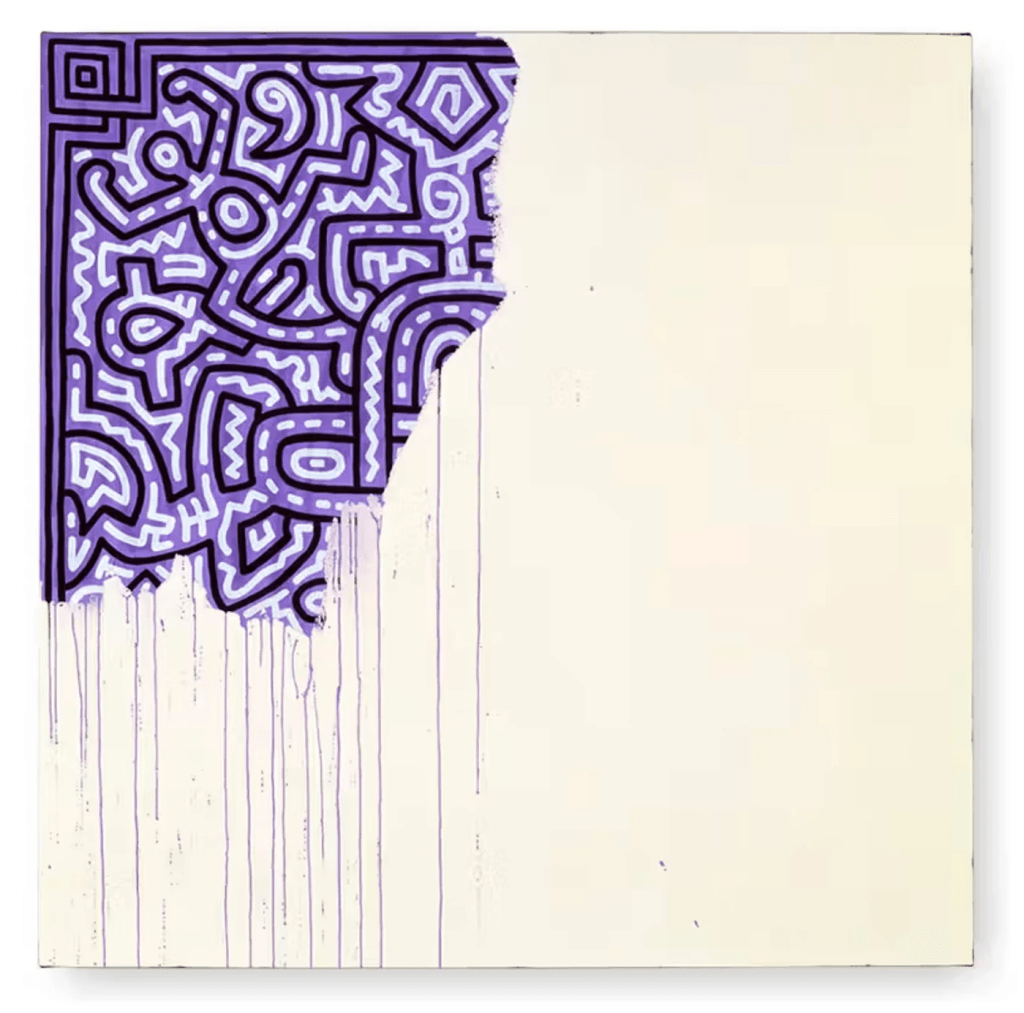
All the work of Keith Haring is deeply significant to me, as my parents love him and I’ve grown up around his art, giving his work a nostalgic and familiar feel. His style is so unique and distinctive, and his work is extremely recognisable. I love Untitled (Dance); something about the colours and simplicity of figures (having no facial features and similar body structure) vigorously dancing together is, to me, the epitome of effortless joy. His Unfinished Painting is truly one of the most poignant artworks I’ve come across. The majority of the page being blank symbolising how Haring’s any many other gay men’s lives in the 80s being cut devastatingly short due to AIDs, thus losing life as well as art and talent, is a pretty difficult examine. It symbolises something so deep and entrenched in recent history, and is a beautiful but tragic memory.
All these pieces from various artists have a story and meaning to me. While I (obviously) don’t have this with all pieces of art, what I can do is understand other pieces of art that are highly revered and valued. While I love Starry Night and think it is beautiful, I don’t have such strong personal ties as I do the aforementioned pieces of art. I can, however, understand and imagine the feelings this artwork could produce for others. In fact, I’ve put together a list of some very famous pieces of art that I feel are more moving and sentimental (even if not to me personally) than the Mona Lisa.
- Monet – The Water Lily Pond
- Gustav Klimt – The Kiss
- Johannes Vermeer – Girl with a Pearl Earring
- Vincent Van Gogh – Café Terrace at Night
- Vincent Van Gogh – Sunflowers
- Salvador Dali – The Persistence of Memory
- Francisco Goya – Saturn Devouring His Son (and all of his Black Paintings really)
Again, open apologies to the art fans and critics out there, as I said I’m still new to art and absolutely none of these are niche or inspiringly different. However, the point remains that all of these convey some kind of feeling: love, nostalgia, peace, some form of strong emotion. I’m still trying to work out what feeling the Mona Lisa conveys. I am aware that it was revolutionary and very impressive and highly skilled for the time. I am by no means saying this painting is not good, or is not influential – that would be incredibly wrong and misinformed. However, I am saying that from a personal standpoint, I don’t think it resonates with the layperson in the same way other paintings do. Does that question its quality and cultural impact? Of course not.
There’s a really interesting YouTube channel that discusses great art in palatable ways, and the Mona Lisa one very beautifully explains the history and creation of the Mona Lisa: https://www.youtube.com/watch?v=ElWG0_kjy_Y&ab_channel=GreatArtExplained. But it still leaves me feeling like this piece of art is misunderstood by me. I understand those who love Da Vinci and other similarly impressive paintings from the Renaissance value this in terms of its cultural significance and skill. No-one (especially not me!) is denying the impact of this masterpiece. But unfortunately that’s not doing it for me, the novice art lover; when looking at this from the perspective of someone not well-versed in the Italian Renaissance period it seems to have its meaning diminished. While I am aware this makes me vastly unqualified to comment, and perhaps negates everything I’ve just said so far, I am still someone who routinely finds meaning from (and often cries) at incredible art pieces. The Mona Lisa makes me realise what I want from art and why it is so vitally important: I want something that makes me feel something, not like I should feel something.

 Chedventures
Leave a comment